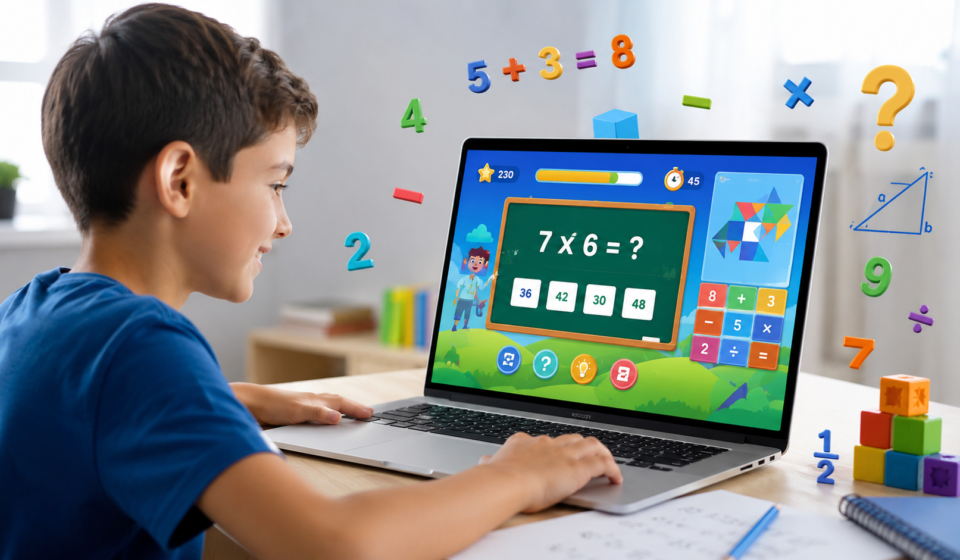

Learning mathematics does not always have to mean sitting with a textbook and solving page after page of equations. For many learners, especially children, interactive activities can make numbers feel less intimidating and much more enjoyable. This is where Math Playzone fits into the picture. The platform brings mathematical practice into a game-based environment where users can work on calculations, logic, speed, and problem-solving while staying engaged.
Math Playzone is designed around the simple idea that practice becomes easier when it feels like play. Instead of treating every calculation as a traditional worksheet exercise, its games turn mathematical questions into challenges that require quick thinking and accuracy. The official platform currently includes games such as Math Push, Math Boy, Quiz Math, Let’s Reach 1000, Let’s Reach Zero, Addition, Subtraction, Multiplication, and Division.
For parents, teachers, and students looking for an accessible way to add more math practice to a routine, Math Playzone can be an interesting option. It does not replace structured teaching, but it can make repeated practice more engaging and give learners another way to interact with mathematical concepts.
What Is Math Playzone?
Math Playzone is an online platform that combines educational games with mathematics practice. Rather than presenting every activity as a conventional lesson, the website uses game mechanics to make users solve problems while progressing through different challenges. This approach can be particularly useful for learners who lose interest when math practice becomes repetitive.
One useful aspect of Math Playzone is the variety of activities available. Some games focus directly on arithmetic, while others introduce logic and strategic thinking. For example, Math Push combines numbered blocks with mathematical expressions, asking players to arrange numbers so they match target values. That makes the activity about more than simply calculating an answer; players also need to think about the sequence and arrangement of numbers.
The platform also includes faster-paced experiences. Math Boy, for instance, asks players to solve arithmetic equations to help defend a character from approaching enemies. It offers addition, subtraction, multiplication, division, and combined modes, creating a more action-oriented way to practise basic calculations.
Why Game-Based Math Practice Can Be Useful
Traditional practice still has an important place in mathematics education, but repetition can become boring when every exercise looks the same. A game-based environment changes the experience by giving learners an immediate reason to continue. Instead of simply completing another worksheet, they may be trying to beat a score, clear a level, or complete a challenge.
This kind of format can encourage repeated practice. When a learner gets an answer wrong, the experience feels more like part of a game than a formal assessment. That can make it easier to try again and learn from mistakes. Over time, repeated exposure to basic operations can help build greater familiarity with numbers.
Another advantage is that different learners respond to different styles of practice. Some students may enjoy strategic puzzles, while others prefer quick questions and time-based challenges. Math Playzone offers both types of experiences, giving users more flexibility in how they approach mathematical practice.
Math Push Encourages Logic and Problem-Solving
Math Push is one of the more distinctive activities on the platform because it combines arithmetic with puzzle-solving. Players move numbered blocks and attempt to create mathematical expressions that match values placed on barriers. The objective is not simply to calculate a number but to work out how the available pieces can be arranged correctly.
That makes the game useful for learners who enjoy taking their time and thinking through a problem. Strategic games can encourage users to consider different possibilities before making a move, which is a valuable habit beyond mathematics. Logical thinking is useful in science, programming, puzzles, and many everyday decision-making situations.
The controls are also straightforward, with movement available through arrow keys or WASD and options for undoing or resetting moves. Keeping the controls simple allows the mathematical challenge to remain the main focus rather than making users learn complicated gameplay mechanics.
Math Boy Makes Arithmetic More Interactive
Math Boy takes a completely different approach. Instead of presenting calculations as a standalone quiz, it connects correct answers to an action-based objective. Players solve equations to protect a sword-wielding character from enemies, while incorrect or slow responses allow the enemies to move closer.
This format can make simple arithmetic feel more urgent. Addition, subtraction, multiplication, and division become part of the gameplay, encouraging players to calculate quickly while maintaining accuracy. For learners who enjoy action games, this can be a more appealing alternative to ordinary timed worksheets.
The game also gives users different mathematical modes. That flexibility means someone who needs extra multiplication practice can concentrate on multiplication rather than constantly switching between unrelated operations. It is a simple design choice, but it can make practice more focused.
Quiz Math Helps Build Speed and Accuracy
Quiz Math is another activity built around quick mathematical decisions. Players see simple addition or subtraction equations and must decide whether the displayed equation is true or false before the character disappears from the screen. Correct answers keep the game going, while mistakes or slow responses can end the round.
The interesting part of this format is the emphasis on mental speed. In everyday mathematics, knowing how to calculate is important, but being able to recognise familiar number facts quickly can also make more complicated problems easier. Strong basic arithmetic fluency gives learners a better foundation for later mathematical work.
At the same time, speed should not become more important than understanding. Teachers and parents can use games like Quiz Math as additional practice rather than treating a high score as proof that a learner understands every mathematical concept. Combining fast games with slower explanations and real-world examples creates a more balanced learning routine.
Practising Addition, Subtraction, Multiplication, and Division
Math Playzone also provides dedicated games for core arithmetic operations. The Addition game challenges players to select the correct sum under time pressure, while Subtraction focuses on finding the correct difference. Multiplication asks users to calculate products quickly, and Division provides practice with division problems.
Having separate activities for individual operations can be helpful because learners often have uneven strengths. A student might be comfortable with addition but still need regular multiplication practice. Being able to focus on a specific operation makes it easier to spend time where it is actually needed.
The timed structure can also add variety to practice. Instead of completing a large collection of questions in one sitting, a learner can play for a short period and then return later. Short, consistent sessions are generally easier to fit into a daily routine than long practice sessions that can quickly become tiring.
How Parents Can Use Math Playzone Effectively
Parents can make Math Playzone more useful by treating it as one part of a broader learning routine. Rather than leaving a child to play indefinitely, they can set a simple goal such as practising multiplication for ten or fifteen minutes. This keeps the activity focused while still allowing the child to enjoy the game.
It can also help to connect digital practice with real-world mathematics. After playing a multiplication game, for example, parents might ask a child to calculate the cost of several items at a shop. After practising addition, they could use household objects or simple budgeting examples to reinforce the same skill.
Most importantly, parents should focus on progress rather than perfection. A learner does not need to achieve a perfect score every time. Making mistakes is a normal part of learning mathematics, and a supportive environment can encourage children to think about why an answer was incorrect instead of simply trying to avoid mistakes.
How Teachers Can Bring Game-Based Practice Into Learning
Teachers can use Math Playzone as a supplementary activity alongside classroom instruction. If a class is currently studying multiplication, a multiplication-focused game can provide additional repetition after the concept has already been explained. This keeps the digital activity connected to an actual learning objective.
Teachers can also use different game styles for different learners. A student who enjoys puzzles may respond well to Math Push, while another student may prefer the faster pace of Math Boy or Quiz Math. Giving learners some choice can increase engagement without removing the academic purpose of the activity.
However, digital games should support teaching rather than replace it. Mathematical understanding involves reasoning, explanation, written work, and applying concepts to unfamiliar situations. Game-based practice is strongest when it works alongside those methods rather than being used as the only form of instruction.
Tips for Getting Better Results From Math Playzone
One of the easiest ways to use Math Playzone effectively is to keep sessions consistent. A short practice session several times a week can be more manageable than attempting a long session once in a while. Consistency gives learners regular contact with the skills they are developing.
It is also useful to choose games according to the learner’s current needs. If multiplication facts are causing problems, focusing on multiplication makes more sense than randomly selecting activities. Once confidence improves, learners can move toward mixed challenges that require them to switch between different operations.
Finally, encourage learners to think about the mathematics behind the game. Ask questions such as why an answer is correct, which strategy worked best, or what could have been done differently. These conversations turn simple gameplay into a deeper learning opportunity.
Is Math Playzone Worth Trying?
Math Playzone offers a straightforward way to make mathematics practice more interactive. Its collection includes calculation games, quizzes, and logic-based challenges, giving learners different ways to work with numbers. The official website presents the platform as a place for both learning and fun, with math alongside science, history, geography, and other educational content.
Its biggest strength is probably its ability to make repeated arithmetic practice feel less like routine homework. Games such as Math Push add strategic thinking, while Math Boy and Quiz Math introduce speed and action. Dedicated addition, subtraction, multiplication, and division activities provide more focused practice.
Still, Math Playzone works best as a supplement rather than a complete mathematics curriculum. Learners benefit most when online games are combined with teacher explanations, books, written exercises, real-world examples, and conversations about how mathematical ideas work.
Final Thoughts on Math Playzone
Math becomes easier to approach when learners have opportunities to practise without feeling constantly tested. Math Playzone uses interactive gameplay to create those opportunities, turning common arithmetic tasks into challenges that can be more engaging than traditional repetition.
Whether someone enjoys strategic puzzles, fast calculations, or simple operation-based games, there are several activities to explore. The key is to use the platform with a clear purpose: practise regularly, focus on weaker skills, learn from mistakes, and connect digital activities with mathematics outside the screen.
For parents and teachers, that balanced approach can make game-based learning more meaningful. For students, it can make a subject that sometimes feels difficult a little more enjoyable. That combination of practice and play is what makes Math Playzone an interesting resource for anyone looking for a more interactive way to work on everyday math skills.
You May Also Read: Dailycrest